A baseball survival guide: pitch types
- Chris Atkins
- Oct 25, 2019
- 4 min read

Updated: Oct 26, 2019
Most people who have not been exposed to baseball think, and understandably so, that pitchers just tend to throw the ball the best they can and hope for the best. And while this is partly true, there is a lot more pitchers can do. Pitchers can impart a multitude of different combinations of speed and spin to the ball which, in turn, will make the ball move and break in a variety of different ways. This can then mess with a batter’s timing or force them to chase a ball outside the zone, all for the single purpose of making outs. What's more, technology has allowed us to see this even more clearly, just take a look at this pitch overlay:

Yu Darvish, the Chicago Cubs’ ace, has an amazing repertoire of pitches:

So as a follow-up to the small “baseball survival guide” I wrote a few weeks ago, I thought I would talk to you about the complex world of baseball pitching. This first article will look at the different types of pitches that a pitcher can throw.
In general, we classify pitches in three different families: the fastballs, the breaking balls, and the off-speed pitches. Depending on the way pitchers grip the ball and their pitching motion, the ball will travel to the plate in a certain way.
When you are watching a game, there are three things you need to pay attention to in order to decipher the pitch type: the speed of the ball, the way it moves and if the ball breaks:
Here is a (non-exhaustive) list of some of the most frequently used pitches.
(Note that all the movements described here are for right-handed pitchers, RHP, for right-handed batters. All movements are mirrored for LHPs)
1) Fastball
As hinted by the name, fastballs rely primarily on speed for effectiveness.
- The 4-seam fastball (4SFB): The 4SFB is probably the most frequently used pitch thrown in baseball. It is also the fastest pitch, ranging from 85 to 105 mph (135 – 170 kph). The ball doesn’t break and has little to no movement.
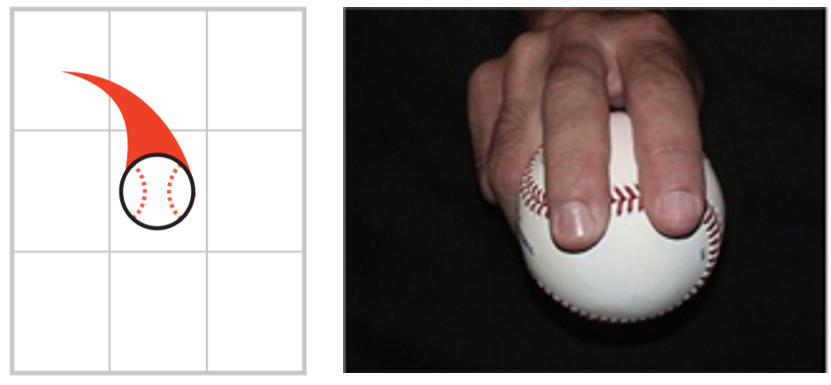

- The 2-seam fastball (2SFB): 2SFBs are another type of fastballs used by pitchers at various levels. Generally speaking, 2-seamers are a few ticks slower than 4SFBs, clocking at 85-95 mph (135 – 150 kph). They also tend to move more, with a downward trajectory and more or less lateral movements that follows the throwing hand (towards the right for RHPs).


- The cutter: A cutter will tend to have the same speed as a 2SFB but its lateral movement will be different, without much vertical movement. The cutting movement will make the ball move away from the pitcher’s throwing arm (i.e. left for RHPs). Yankee’s pitcher Mariano Rivera's cutter was absolutely devastating to batters during his stint in the major league.


- The splitter: Still in the fastball family are splitters. Slightly slower than the others fastballs (80 – 90 mph, 130 – 145 kph), splitters are named this way because the pitcher has to literally split his fingers on either side of the ball. Splitters are annoying for batters as they will drop suddenly just before reaching the plate. Look at young Japanese two-way player Shohei Ohtani for a good splitter.


2) Breaking balls
Breaking balls move, a lot, they’re slower than fastballs but can be as, if not more, effective.
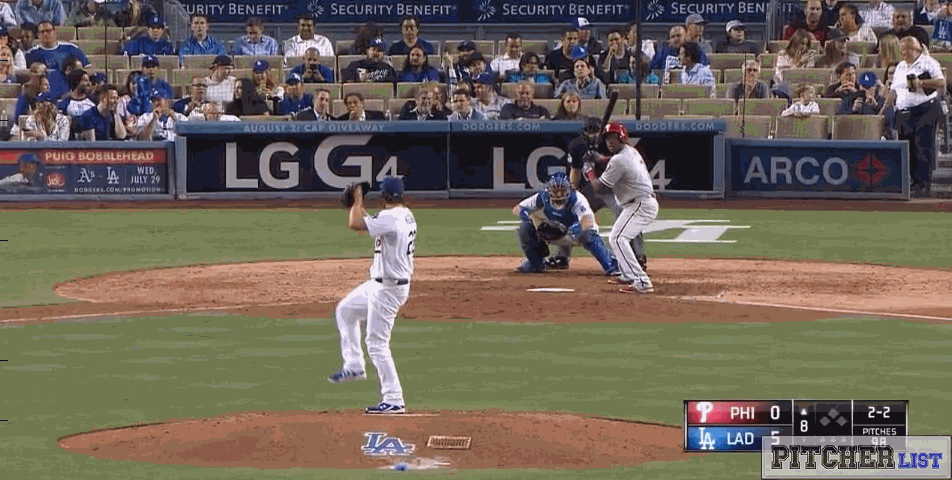
- The curveball: The movements you see for the various pitches described here are a result of the spin of the ball. Fastballs spin backward. Curveballs, on the other hand, have a forward spin, giving them a lot of movement. We usually say the ball has a 12-6 movement. This is because as a batter you see the ball go up out of the pitcher’s hand, before breaking downwards. On average, curveballs travel at 65 – 85 mph (105 – 135 kph) and, if you want to look for a filthy curveball, look at Dodgers’ Clayton Kershaw’s curveball.

- The slider: A slider is slightly faster than a curveball but also has fewer movements. They are similar to those of a cutter, but about 5-10 mph slower. The lateral spin of the slider makes it look like a red-dot appears at the center of the ball, which can sometimes tip batters off as to what is coming. Zack Greinke, currently pitching for the Houston Astros, has a great slider.


3) Off-speed pitches
Off-speed pitches come in the form of what we refer to as changeups. Changeups are the slowest pitches in baseball with 70 to 85 mph on the radar (110 – 135 kph). Changeups are meant to have the same movement and spin as a fastball, relying on their speed to fool batters and throw their timing off. My personal favorite changeup pitcher is National’s veteran Max Scherzer.


4) Knuckleballs
A little bonus with knuckleballs. As my coach used to say: “knuckleballs do whatever the hell they want.” Pitchers who throw knuckleballs are very rare and tend to use this pitch almost exclusively. The thing about knuckleballs is that they have close to no spin with very little velocity (60 – 70 mph, 97 – 113 kph). This makes their movement erratic and unpredictable. This is probably the weirdest/most difficult pitch to hitch and batters, including yours truly, hate when they have to face knuckleballers. R.A. Dickeys is one of the few famous knuckleballers of the last few years.
So here you go, this list is absolutely not an exhaustive one, I could've told you about slurves, screwballs, palmballs etc... but the ones I have given you are, I believe, the ones you're most likely to see during a game. Next time, I will talk about pitcher usage and pitching strategy.
Take care!
- Chris
References


Comments